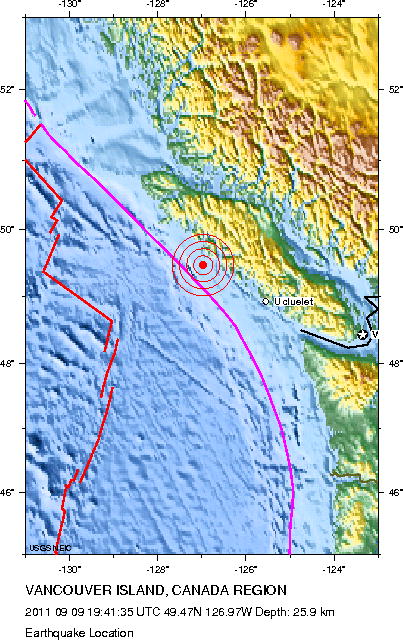
Although there have been a few quakes around since we have been out in Washington, Friday was the first quake that I felt. At 12:41pm a 6.4 magnitude earthquake struck off the coast of Vancouver Island.
 I was
I was sat sitting in my office and to be honest I probably wouldn’t have even noticed it if it hadn’t been for the blinds in my office. They started swaying and banging against the side of the wall. At first I couldn’t work out what it was – other than my office being haunted my best guess was that maybe some work was being done in an office above or to the side – it was only when Tevin said that “I think we’re having an earthquake” that it even dawned on me!
I stood up as it was then that I felt the building moving a bit. Not lots but enough to make my legs go funny! The blinds probably kept swaying and banging into the wall for a couple of minutes before they stopped. In the meantime lots of people who I’ve not seen before appeared out of offices and announced that “we’re having an earthquake”!
Anyway, the detail of the earthquake can be found on the US Government earthquake site. It was just a tiny one in the grand scheme of things but it was quite exciting for a few minutes!
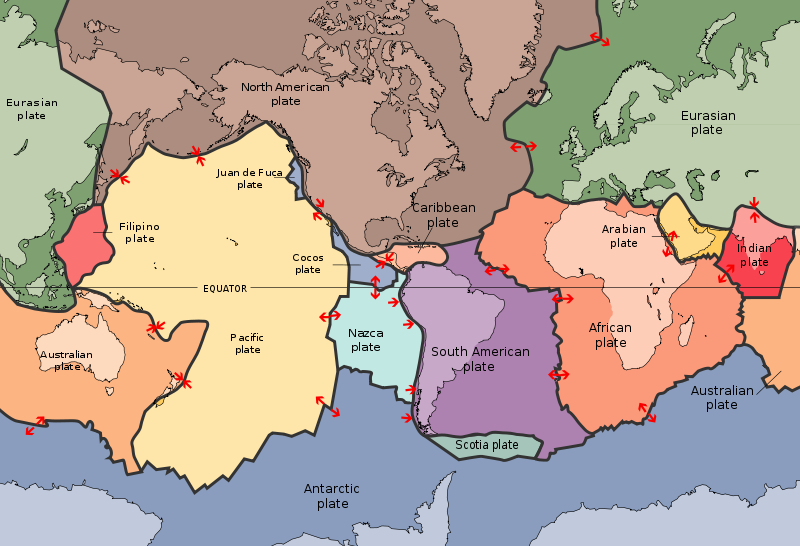
Now moving onto a more scientific review. Apparently this part of the earths crust (Pacific NorthWest) has the smallest tectonic plate – the Juan de Fuca plate. It is named after the explorer of the same name, a 16th Century Greek explorer from Kefalonia.
This tectonic plate was generated from the Juan de Fuca Ridge, and sub-ducting under the northerly portion of the western side of the North American Plate at the Cascadia sub-duction zone. It is bound on the south by the Blanco Fracture Zone (running northeast off the coast of Oregon, USA), on the north by the Nootka Fault (running southwest off Nootka Island, near Vancouver Island, Canada), and along the west by the Pacific Plate (which covers most of the Pacific Ocean and is the largest of Earth’s tectonic plates).
The smallest of Earth’s tectonic plates, the Juan de Fuca Plate is a remnant part of the once-vast Farallon Plate, which is now largely subducted under the North American Plate. The Juan de Fuca plate itself has since fractured into three pieces, and the name is applied to the entire plate in some references, but in others only to the central portion. When the three fragments are so distinguished, the piece to the south is known as the Gorda Plate and the piece to the north is known as the Explorer Plate. The separate pieces are demarcated by the large offsets of the undersea spreading zone.
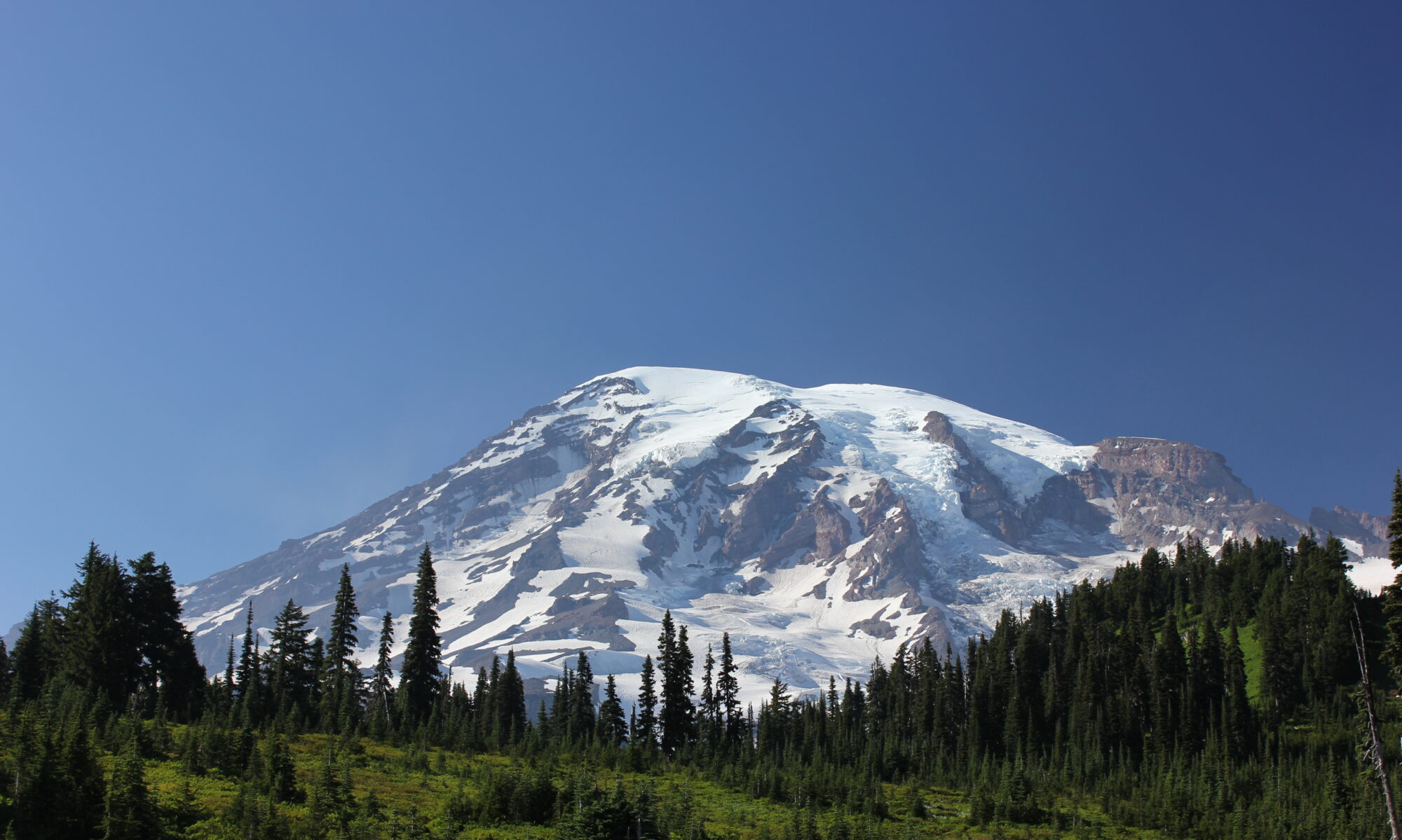
This subducting plate system has formed the Cascade Range, the Cascade Volcanic Arc, and the Pacific Ranges, along the west coast of North America from southern British Columbia to northern California. These in turn are part of the Pacific Ring of Fire, a much larger-scale volcanic feature that extends around much of the rim of the Pacific Ocean.
There is speculation that the Ring of Fire is flexing its muscles. It started with the large earthquake in Japan last year (or was it this year? I can’t remember!), followed by a large earthquake in Alaska not so long ago, and now this little quake. Maybe there is going to be a large quake further down the coast – it appears to be moving in a clockwise direction?
As long as it doesn’t hit Bellevue that’s the main thing – I can cope with a 6.4 quake and more importantly so can the buildings, so I think that will do for me!
I was SITTING…
Sorry! I’ve updated it!
Just keeping you on your grammatical toes!!